
When you’re quoting HVAC systems, you’re not just lining up equipment—you’re guiding homeowners through a decision they don’t make often and don’t fully understand. The Power of Option Labels lies in how simple, strategic naming can shape that decision. Built for HVAC pros, this guide shows how to use proven choice-architecture psychology to boost close rates and make your proposals work harder for you.
Why Choice Architecture Matters
Homeowners rely on shortcuts when comparing options. Use them to your advantage:
- Anchor – The first option sets the bar.
- Baseline – Establishes a starting point for comparing value.
- Social Proof – People choose what others choose.
- Loss Aversion – Customers avoid the “wrong” choice by picking the safe middle.
Most homeowners won’t select your cheapest or highest-priced option. They land in the “smart middle.” That’s exactly where good labeling guides them.
The 4-Option Framework
For HVAC quotes, this structure wins:
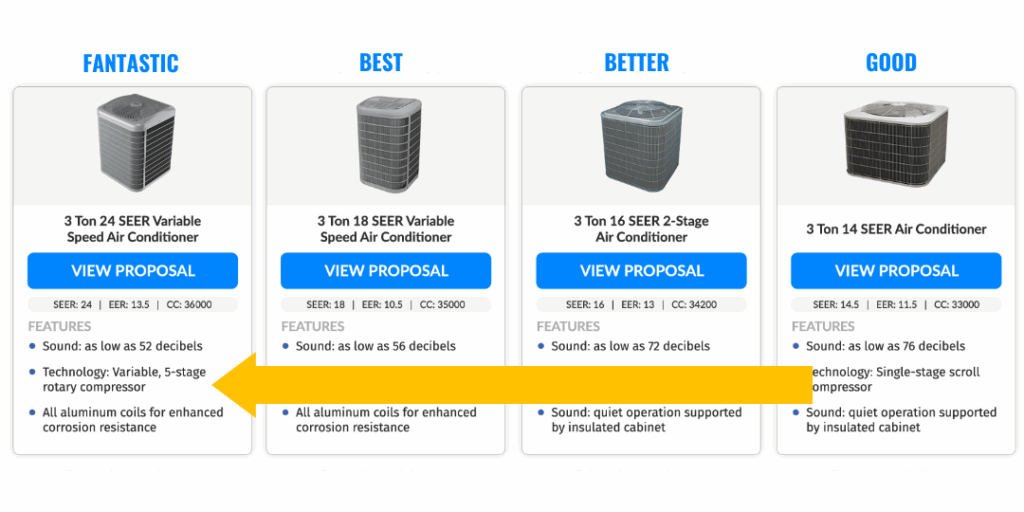
- Basic – A workable but clearly limited choice
- Good – Solid baseline
- Better – Your sweet spot
- Best – Premium or future-proofed
This layout naturally channels customers toward the Better option—where value and comfort align.
Five Option Labeling Strategies That Work
Each strategy includes examples and the psychology behind them.
1. Efficiency Ladder
Labels: “Lowest Eff”, “Standard Eff”, “Premium Eff”, “Max Efficiency”
Why it works: Logical, number-driven buyers don’t want the “lowest” anything—especially when it affects their bills.
2. Investment Language
Labels: “Basic Invest”, “Smart Invest”, “Premium Invest”, “Ultimate Invest”
Why it works: Reframes cost as ROI. “Smart” makes customers feel intelligent about choosing the middle.
3. Social Proof Positioning
Labels: “Budget Opt”, “Most Popular”, “Cust Favorite”, “Premium Choice”
Why it works: People follow the crowd. Popularity reduces fear of choosing wrong.
4. Comfort Progression
Labels: “Basic Comfort”, “Enhanced Cft”, “Premium Cft”, “Ultimate Cft”
Why it works: Emotion sells. Once homeowners picture “ultimate comfort,” they don’t want to downgrade.
5. Personal Recommendation
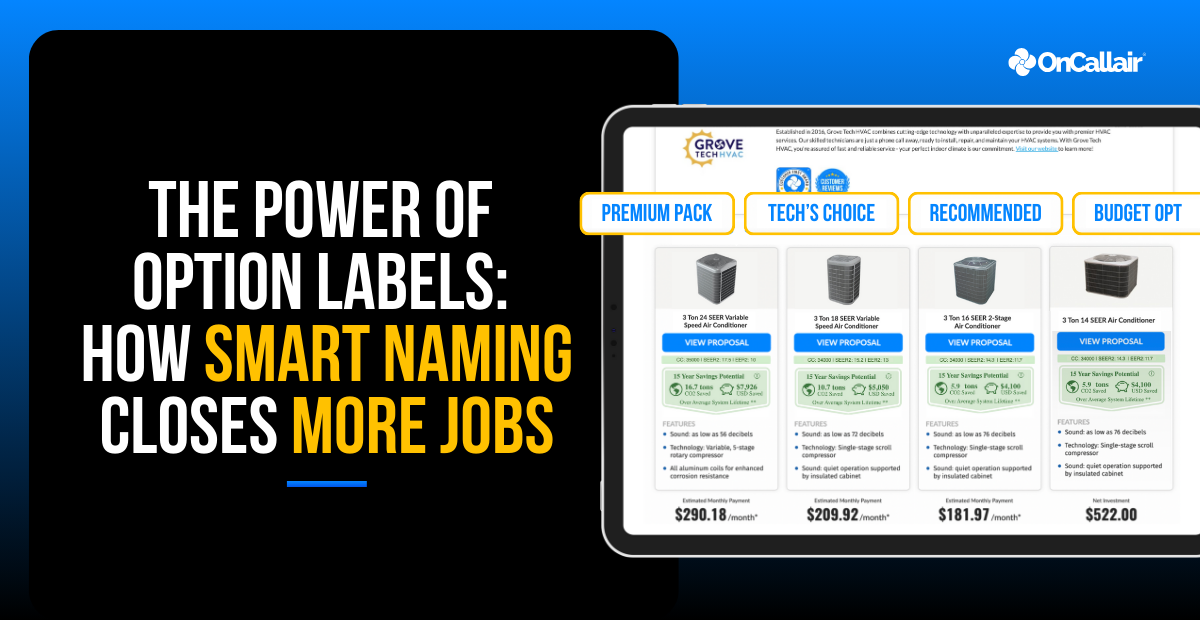
Labels: “Budget Opt”, “Recommended”, “Tech’s Choice”, “Premium Pack”
Why it works: Your opinion matters. Customers trust what you’d put in your own home.
How to Choose the Right Strategy
Start with a default, then adjust on the fly based on customer cues.
Default Strategy
Use Efficiency Ladder first. It works for the broadest range of homeowners.
Real-Time Adaptation Cues
Switch strategies when you hear:
“What do most people pick?” → Social Proof
“I just want to be comfortable.” → Comfort Progression
“What would you do?” → Personal Recommendation
“Show me the numbers.” → Efficiency Ladder
“Is this worth the money?” → Investment Language
Customization Tips
Rename options mid-presentation if needed (OnCall Air let’s you change labels on the fly, see how).
Match tone to the homeowner, not your default habits.
Keep labels clean and under 20 characters for optimal display.
Do’s and Don’ts
DO
Make the decoy real but clearly less appealing
Highlight your target option as the “smart” choice
Use labels that fit the homeowner’s personality
Keep everything readable and simple
DON’T
Overdo the decoy—customers can smell a gimmick
Use one strategy for everyone
Push the premium option too hard
Ignore verbal cues that tell you what the customer values
The Bottom Line
Your labels aren’t decoration—they’re decision-drivers. When you apply the right naming strategy at the right moment, homeowners feel more confident, your proposals get clearer, and your close rates climb.
Leverage these simple label frameworks, listen for cues, and guide customers toward the option that truly fits their home. The top HVAC pros don’t just quote equipment—they design choices that lead homeowners to the best outcome.